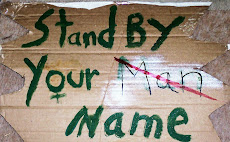
I’ve noticed that whenever a woman defends having taken her husband’s name, or defends dressing provocatively, it’s invariably stated, “After all, feminism is about choice.” Well I’m not pleased with having women who choose tradition, or patriarchy, telling me what feminism “is about”.
Take the word “choice”. Somehow, when a woman explains her decision to take her husband’s name as a choice, it feels like she’s using the term in the sense of “I choose vanilla; you choose chocolate”, i.e., there's no implication, no greater statement being made; it's simply a matter of what you like and what I like. But the difference between choosing ice cream flavors and choosing which name to use is that the former has no values attached, while which name one uses very much reflects one’s values.
In this sense, I can’t really go with “feminism is about choice”. To me it’s akin to an African-American saying, “The civil rights movement was about choice, and I choose to sit at the back of the bus.” Unlikely, I’d say. So why is feminism any different? Feminism is about choice in the sense that it’s about women having choices other than the traditional ones; we don't need feminism in order to opt for tradition -- traditional roles have been "freely available" for the past 10,000 years.
Therefore I see feminism as being about parity (notice I didn’t say “equality”, God forbid), i.e., being on a par with men; and when I take someone else’s name, I’m by definition not on a par with him. Ditto when I intentionally dress (or dress my daughter) so as to objectify myself in men’s eyes. How can I be on a par with someone who views me as an object?
Moreover, it doesn’t strike me that someone who chooses to take her husband’s name is sincerely concerned about her “choices” being jeopardized. In a world where at least half of all women retained their birth names, such a woman might indeed feel pressured to do so, but we’re not even close to that world. On the other hand, stay-at-home moms do feel pressured to work for an income, but I doubt that that pressure is coming from feminist circles; more likely it’s economic pressure coming from within their own households.
In actuality, it’s democracy that’s about choice. In a democracy, we’re free to choose traditional lifestyles a la Amish or ultra-Orthodox, as long as we don’t impose them on the rest of the citizenry. Yet it seems disingenuous for women making traditional choices to invoke feminism in the defense of those choices, especially when it’s only when it serves them that they even bother to acknowledge feminism.
And, what exactly are they acknowledging when they say, “feminism is about…”? It appears to refer to a rather fuzzy code for “Some 1970s struggle that ended the Dark Ages”. How many of you who parrot “feminism is about choices” have actually read feminist literature, taken a gender studies class, or attended a consciousness-raising session?
I rather conceive of feminism as precisely being about questioning assumptions, pushing the boundaries, even rocking the boat, and yes, doing the uncomfortable thing. Taking your husband’s name does none of these; an eight-year-old wearing a top emblazoned with “So Many Boys, So Little Time” is making a statement…unfortunately a twisted one.
I will rejoice when we get to a place where retaining our names is the comfortable thing; when Western society finally strikes that sartorial balance between repression and promiscuity. Until then, please don’t drag feminism in when defending your having chosen to settle into comfortable, traditional roles.
Added February 13, 2011- quote from Haxer Beck2:
"Traditional ladies didn't have to pay for anything, but they didn't get to have sex until they were married, and the only decisions they ever got to make in their lives were whether to say Yes or No to an offer of marriage, and what they were going to wear.
Modern ladies get to do whatever they want (as long as it's considerate of others), AND they pay for that privilege by taking full responsibility for their own material support and well-being.
A woman can pick either system and still be a lady -- but she can't enjoy the rights from one system and ditch its associated responsibilities."
Thursday, June 17, 2010


Wednesday, April 28, 2010
Party of Five שולחן לחמישה
When Gilmore Girls was dropped from the local channel, it left a hole in my day. So I checked out the series that replaced it in its time slot, Party of Five (I know, I know: I’m 15 years behind the times. Just humor me).
First let’s get something out of the way: Yes, Pof5 engages me; you could even say I’m hooked, because I want to know what happens next, and I even — I admit it — analyze it when I’m not watching, i.e., “Charlie should’ve moved them to Seattle”; “Why does Bailey have to go to college 2,000 miles away?” “Julia was so out of line talking about Justin to his mom”.
So while there’s no question that I enjoy the program, there’s a disturbing undercurrent running through it: Do viewers get that the way the characters operate in their relationships is a model of how not to do relationships? I’m not referring only to the incessant cheating; I can deal with that. It’s that every couple seems to have two modes: Deliriously in love, or quarreling, the latter always seeming to stem from an innocent remark from which offense was taken, along the lines of:
Character A: You need to act responsibly here…
Character B: Responsibly? Excuse me! What do you know about responsibility?!
Character A: Look, all I’m saying is that maybe it wouldn’t be the end of the world if you’d…
Character B: Oh! Like you’re so perfect! I suppose you expect me to…!
It’s disturbing to think that young viewers may think that the above is a normal relationship pattern. Not to mention that the emphasis in Charlie and Kirsten’s almost-wedding seemed to be on one thing: forsaking all others. Not joining their lives, compromising, working as a team, putting each other’s happiness first…but forsaking all others, as if marriage is nothing but a relationship version of traffic law, i.e., just don’t exceed the speed limit, and you’ll be fine.
All in all, simplistic, served up as realistic. I know: It’s “just” TV; we can’t expect it to reflect real life. Yet we can’t ignore that it does feed into viewers’ — especially young viewers’ — concepts of what to expect from real life. I’d like to think that my kids will dig deeper and shoot higher than do the Salingers.
First let’s get something out of the way: Yes, Pof5 engages me; you could even say I’m hooked, because I want to know what happens next, and I even — I admit it — analyze it when I’m not watching, i.e., “Charlie should’ve moved them to Seattle”; “Why does Bailey have to go to college 2,000 miles away?” “Julia was so out of line talking about Justin to his mom”.
So while there’s no question that I enjoy the program, there’s a disturbing undercurrent running through it: Do viewers get that the way the characters operate in their relationships is a model of how not to do relationships? I’m not referring only to the incessant cheating; I can deal with that. It’s that every couple seems to have two modes: Deliriously in love, or quarreling, the latter always seeming to stem from an innocent remark from which offense was taken, along the lines of:
Character A: You need to act responsibly here…
Character B: Responsibly? Excuse me! What do you know about responsibility?!
Character A: Look, all I’m saying is that maybe it wouldn’t be the end of the world if you’d…
Character B: Oh! Like you’re so perfect! I suppose you expect me to…!
It’s disturbing to think that young viewers may think that the above is a normal relationship pattern. Not to mention that the emphasis in Charlie and Kirsten’s almost-wedding seemed to be on one thing: forsaking all others. Not joining their lives, compromising, working as a team, putting each other’s happiness first…but forsaking all others, as if marriage is nothing but a relationship version of traffic law, i.e., just don’t exceed the speed limit, and you’ll be fine.
All in all, simplistic, served up as realistic. I know: It’s “just” TV; we can’t expect it to reflect real life. Yet we can’t ignore that it does feed into viewers’ — especially young viewers’ — concepts of what to expect from real life. I’d like to think that my kids will dig deeper and shoot higher than do the Salingers.
Tuesday, April 13, 2010
Netiquette, please נימוסים אלקטרוניים, בבקשה
E-mail having been around since 1996, and most literate folks having gotten on the bandwagon by 2000, a decade should be sufficient time for us all to’ve gotten used to it, and for the novelty to’ve worn off. Why, then, am I still getting mail with “Fwd Fwd Fwd Fwd Fwd…” in the Subject line? Why are people still sending me mass mailings in 24 boldface font, three words to a line, and with a lifetime supply of exclamation points?!!!!!!!!!!!!!!! Why is the message preceded and followed by a meter-long list of recipients’ addresses? And why am I instructed to “Hit forward and send this to everyone you know”? If you’re under eight or over 80 years of age, you get a pass from me. The rest of you, please heed:
1. A To or cc field with inches of addresses says, “Not serious; not businesslike”. When you send these out, you’re failing to protect your friends’ and others’ privacy. Learn to bcc.
2. Subject lines containing “Fwd” are spam magnets. Delete “Fwd” both in the Subject line and in the body of the mail.
3. Learn to compose a decent Subject line. Examples of the lame and the annoying: “Important! Please forward!”; “Hi”; “ " (that’s an empty Subject line; the first two examples might as well be empty, as they give no useful information whatsoever).
4. Trim off all excess “froms”. We don’t need to read them, and it’s annoying to have to scroll all the way down to Antarctica to read a mail.
5. Read through what you’re about to send. Ask yourself what impression it gives. Oversize lettering and multiple colors screams, “Written by a fourth grader!” Consider selecting the entire letter (Ctrl + A), going to your Format menu, selecting Rich Text, and adjusting the font(s) and color(s) (Format menu > Font). If you’re really ambitious and have the time, fix the double spaces and dial back those exclamation points. Correct spelling wouldn’t hurt either. And finally…
6. I don’t need to be told to forward mail any more than I need to be told to tell people my opinion on an issue or my impression of a product; it’s implicit. And can we lose the expression “Hit Forward” and “Hit Reply”? First of all, none of us should be hitting anything. We press keys on our keyboards, i.e., “Press Enter”; “Press Escape”. We click buttons using our mouses, i.e., “Click OK”; “Click this link”. And we simply forward mail…after performing all of the above steps.
1. A To or cc field with inches of addresses says, “Not serious; not businesslike”. When you send these out, you’re failing to protect your friends’ and others’ privacy. Learn to bcc.
2. Subject lines containing “Fwd” are spam magnets. Delete “Fwd” both in the Subject line and in the body of the mail.
3. Learn to compose a decent Subject line. Examples of the lame and the annoying: “Important! Please forward!”; “Hi”; “ " (that’s an empty Subject line; the first two examples might as well be empty, as they give no useful information whatsoever).
4. Trim off all excess “froms”. We don’t need to read them, and it’s annoying to have to scroll all the way down to Antarctica to read a mail.
5. Read through what you’re about to send. Ask yourself what impression it gives. Oversize lettering and multiple colors screams, “Written by a fourth grader!” Consider selecting the entire letter (Ctrl + A), going to your Format menu, selecting Rich Text, and adjusting the font(s) and color(s) (Format menu > Font). If you’re really ambitious and have the time, fix the double spaces and dial back those exclamation points. Correct spelling wouldn’t hurt either. And finally…
6. I don’t need to be told to forward mail any more than I need to be told to tell people my opinion on an issue or my impression of a product; it’s implicit. And can we lose the expression “Hit Forward” and “Hit Reply”? First of all, none of us should be hitting anything. We press keys on our keyboards, i.e., “Press Enter”; “Press Escape”. We click buttons using our mouses, i.e., “Click OK”; “Click this link”. And we simply forward mail…after performing all of the above steps.
Sunday, April 11, 2010
A Cleric Speaks Out For Separation of Church & State כומר בעד הפרדת דת ומדינה
I finally tracked it down after 17 years, with the help of Dwight Tawney and Caroloyn Nussbeck of the Village Presbyterian Church in Prairie Village, Kansas: A sermon delivered by their Pastor Emeritus the Rev. Doc. Robert H. Meneilly, and reprinted in the New York Times in 1993. It was probably reprinted in whatever English language paper I read at the time, and I never forgot it. I'm posting a link to it here (you don't even need to download the doc; just click on the above link and read), but for those who don't feel like slogging through the entire four pages, I'm reprinting what I feel to be the salient quotes:
- Any religion that needs the government to support and subsidize it doesn't deserve to survive. It's not the state's business to carry out the churches' ministries!
- Any religion that must depend upon the state to do what it cannot do [i.e., force the citizenry to observe the commandments] is not worthy of existence...even Christianity.
- When the state and the church would become entwined, it is the latter that will be the loser.
- We can't uphold the...commandments by majority rule!
As far as I'm concerned, that says it all as far as church and state. Would that more clerics and religious leaders were as courageous as Rev. Meneilly, who a friend calls "an icon in the 'burbs"*.
*Johnson County, KS, where his church is located. Think Ultimate Suburbia, and you're there.
Thursday, March 25, 2010
Why Popeye Has to Defend OliveOyl ?מדוע חייב פופיי להגן על אוליב אויל
A friend sent me Yet Another Article citing a “study” finding that male and female brains differ, and therefore 'proves' that the genders are destined to behave according to long-held stereotypes. Since you have to sign up as a member to comment (I hate that. What’s that all about?), and I don’t want to become a “member” of Yet Another Forum, I’ll sound off here, where I’m a member of my own club and anyone with a computer is welcome and encouraged to comment.
Dr. Louann Brizendine is here to tell us among other things that “his amygdala, the alarm system for threats, fear, and danger is...larger in men…making men more alert than women to potential turf threats.”
Why, then, are women the stereotyped worriers, and the ones who are stereotyped as getting up on a chair and shrieking if we see a mouse or a spider?
Dr. Brizendine goes on to explain how male’s brains are the reason they constantly check out women and stare at their breasts, and why, when we tell them our problems, they go into Fixit Mode. She concludes by proverbially throwing up her hands and sighing that it makes more sense to deal with these brain realities, than to argue with them or ignore them…”The best advice I have for women is make peace with the male brain. Let men be men.”
Ah, yes. Let men be men: It’s just one molecule away from “boys will be boys”. It’s all wired in. It’s in their DNA. Not a darned thing we can do. Why even try to civilize them?
Dr. Brizendine's credentials notwithstanding, this is simplistic pop drek parading as science and excusing gender stereotyping.
Dr. Louann Brizendine is here to tell us among other things that “his amygdala, the alarm system for threats, fear, and danger is...larger in men…making men more alert than women to potential turf threats.”
Why, then, are women the stereotyped worriers, and the ones who are stereotyped as getting up on a chair and shrieking if we see a mouse or a spider?
Dr. Brizendine goes on to explain how male’s brains are the reason they constantly check out women and stare at their breasts, and why, when we tell them our problems, they go into Fixit Mode. She concludes by proverbially throwing up her hands and sighing that it makes more sense to deal with these brain realities, than to argue with them or ignore them…”The best advice I have for women is make peace with the male brain. Let men be men.”
Ah, yes. Let men be men: It’s just one molecule away from “boys will be boys”. It’s all wired in. It’s in their DNA. Not a darned thing we can do. Why even try to civilize them?
Dr. Brizendine's credentials notwithstanding, this is simplistic pop drek parading as science and excusing gender stereotyping.
Friday, March 19, 2010
Christmas. Yeah, Christmas. חג המולד
As I’ve mentioned on occasion, I’m a *chasida* [follower] of Washington Post columnist Carolyn Hax’s commenters’ forum. The other day Hax ran a letter from a reader who was offended that his Christian MIL (that’s mother-in-law) sent him, his Jew-by-choice wife, and their four-year-old son Christmas cards. Unfortunately, the LW (that’s letter-writer) didn’t arouse too much sympathy, as he also complained that MIL gave them a cash gift, as opposed to one she picked out. Now I’m all down with the second point; heck, I’ll accept cash from any source, even if it’s the Islamic Jihad Clearinghouse Sweepstakes. But the ensuing discussion about card-sending (which elicited no fewer than 287 comments) aroused some latent defensiveness in me vis-à-vis Christmas in America that the Hax discussion finally enabled me to articulate after all these years. My visceral reaction to Christmas is so strong, in fact, that despite having left it behind 29 years ago, I was surprised that I still haven’t actually let go of it.
So, for any American Christians reading this, here's my Knee-Jerk anti-Christmas Primer. And yes, for my purposes, “Christian” refers to you even if you weren’t baptized and have never stepped foot in a church, as long as you don’t actively affiliate or identify with another faith. OK, now that we've got that sorted out, here we go: The LW got all hot under the caller ‘cause his MIL sent him a Christmas card — a seemingly innocuous act, right? And predictably, within the first dozen comments, someone piped up with, “I’ve gotten Chanuka cards and wasn’t offended”, to which I replied:
Christians getting Chanuka, Divali, or Eid cards and not being offended in a Christian-majority society proves nothing. Minority members — the laid-back poster above notwithstanding — tend to be sensitive on this and other fronts, and not without grounds, even if those grounds date back decades or centuries: They’re still part of our group’s collective consciousness. Call it paranoia if you want, but if you haven’t been one, you can’t judge.
Another poster commented: “The Jewish people I know all celebrate Christmas”, to which I replied:
This is akin to telling a blond joke, and when the blond you’re telling it to gets offended, saying to her, “But all my other blond acquaintances thought it was funny.” So you know a few assimilated Jews; does that make you an authority on Jewish observance? I’ll detour here to say that it also pushes my buttons when year after year on December 25th, some fellow ex-pat gigglingly greets me with “Merry Christmas” and then goes on to wax nostalgic about the Christmas carols of her childhood and memories of helping the neighbors trim their tree. It always makes me want to say, “Are you trying to shoe how worldly you are, having come from the multi-cultural West? ‘Cause I’m from there too, and I’m not impressed”.
It’s also ignorant to draw conclusions about a group based on the members thereof that you happen to know. I recall a (nominally) Jewish teacher harassing an Orthodox classmate when the latter told the former that he’d be absent on Succot. The teacher said, “What do you mean it’s a Jewish holiday? I’ve never heard of it!” When I tried to vouch for my classmate, telling the teacher that Succot indeed exists (this was pre-Internet) and it is indeed forbidden to work thereon, he asked me if I’d be in class on Succot. When I replied in the affirmative, he predictably said to my classmate, “See? She’s going to be here, so why can’t you?” It’s called nuances, or in this case, differing levels of religious observance. A university journalism teacher should be sensitive to these, no?
Another poster commented that she didn’t understand what all the fuss is about as she’d never received a Rosh haShana card. To which I replied:
Chanuka is not a Christmas equivalent, and card-sending is not an inherently Jewish tradition. My parents’ generation sends out Jewish New Year cards, which falls in September-October, to their Jewish friends. That explains the fact that you’ve never gotten one.
Another poster tried to smooth things over by saying how she simply sends everyone on her list regardless of religion her usual Christmas cards. Another described the whole issue as “just one big happy diverse soup”, to which I replied:
It works like this: Christians have their Important Holiday on December 25, so many of them (excepting the enlightened group here) assume that everyone has Something To Celebrate circa December 25th. You send your friends "the usual Christmas card". Nice. What you need to understand is that for non-Christians, there is no such thing as "the usual Christmas anything". It's this assumption on the part of (many) Christians that galls (many of) us non-Christians. Sorry. It's my upbringing. This is just not an issue I can get all Zen and soupy about...
To the commenter who claimed that the LW “…is missing out on and not learning a thing about his MIL’s traditions”, I referred to another Jewish poster’s references to: “…so overwhelming is the [Christmas] cheer with the movies, decorations, lights, commercials, sales, concerts: It's impossible not to get sucked in!” I wrote:
Pennagirl, "learn about MIL's traditions"? Are you kidding? Did you read Tscoll’s post? In order to "learn about" Christianity in the US, the only requirement is to have a pulse and watch TV: You absorb it into your pores by osmosis. In fact, if you can wrap your head around it, "Happy Holidays" and "Seasons Greetings" is almost as presumptuous (perhaps more -- I haven't decided) as "Merry Christmas". The presumption that "OK, we get that you don't celebrate Christmas, but you MUST celebrate SOMETHING at this time of year", i.e., there is something inherently spiritual or joyous about the period between Thanksgiving and Gregorian New Year akin to the sun rising every morning, therefore I greet you with "Good morning". (What? Your religion doesn't recognize mornings???!!!). It is just so hard for Majority America (for lack of a better label for this category) to internalize that December 25th is just another day for us, like the 10th of Tishrèi is to you all. Except unlike the 10th of Tishrèi, of which you walk around all day utterly unaware, Christmas is In Our Faces; we feel assaulted by it. Though we'd like to, we can't just pretend like it's any other day. Believe it or not.
Finally, I agree that the LW seems to be looking for offense where there is probably none intended. I was just trying to give the majority members in this forum a window into what makes minority members tick, i.e., what may push our buttons. I don’t mean to sound bitter; I'm just tellin' it like it is, through my lens, having grown up as an identifying Jew in the US. For any of you who “get it”, you’ll understand this: I'd jump for joy if just one retail clerk between Thanksgiving and Gregorian New Year were to bless me with a generic, "Thank you. Have a nice day".
*
Tangentially, I was reminded just yesterday of how cringe-producing it is when the screenwriters of TV series try to “do Jewish”: I was watching the Party of Five episode wherein Claudia contemplates converting to Judaism for her preteen Jewish boyfriend. Arty’s attempts to explain Judaism “while standing on one foot” are superficial at best, pathetic at worst.
Regarding “the rules”, he tells her about “kosher” [kashrut] by explaining, “You’re not allowed to eat lobster or shrimp, and you can’t have a hamburger together with a milkshake”. When Claudia’s face falls, Arty reassures her, “But you don’t have to be kosher [observe kashrut]; we’re not.” Oy vey! And the actor’s awful attempts at Hebrew (or in this case Aramaic): *yees go dole, vah yees go dosh, shmay row bow*. Gawd. Please, screenwriters-attempting-to-be-diverse: Spare us this torture. We’re all blushing beet-red on your behalf.
So, for any American Christians reading this, here's my Knee-Jerk anti-Christmas Primer. And yes, for my purposes, “Christian” refers to you even if you weren’t baptized and have never stepped foot in a church, as long as you don’t actively affiliate or identify with another faith. OK, now that we've got that sorted out, here we go: The LW got all hot under the caller ‘cause his MIL sent him a Christmas card — a seemingly innocuous act, right? And predictably, within the first dozen comments, someone piped up with, “I’ve gotten Chanuka cards and wasn’t offended”, to which I replied:
Christians getting Chanuka, Divali, or Eid cards and not being offended in a Christian-majority society proves nothing. Minority members — the laid-back poster above notwithstanding — tend to be sensitive on this and other fronts, and not without grounds, even if those grounds date back decades or centuries: They’re still part of our group’s collective consciousness. Call it paranoia if you want, but if you haven’t been one, you can’t judge.
Another poster commented: “The Jewish people I know all celebrate Christmas”, to which I replied:
This is akin to telling a blond joke, and when the blond you’re telling it to gets offended, saying to her, “But all my other blond acquaintances thought it was funny.” So you know a few assimilated Jews; does that make you an authority on Jewish observance? I’ll detour here to say that it also pushes my buttons when year after year on December 25th, some fellow ex-pat gigglingly greets me with “Merry Christmas” and then goes on to wax nostalgic about the Christmas carols of her childhood and memories of helping the neighbors trim their tree. It always makes me want to say, “Are you trying to shoe how worldly you are, having come from the multi-cultural West? ‘Cause I’m from there too, and I’m not impressed”.
It’s also ignorant to draw conclusions about a group based on the members thereof that you happen to know. I recall a (nominally) Jewish teacher harassing an Orthodox classmate when the latter told the former that he’d be absent on Succot. The teacher said, “What do you mean it’s a Jewish holiday? I’ve never heard of it!” When I tried to vouch for my classmate, telling the teacher that Succot indeed exists (this was pre-Internet) and it is indeed forbidden to work thereon, he asked me if I’d be in class on Succot. When I replied in the affirmative, he predictably said to my classmate, “See? She’s going to be here, so why can’t you?” It’s called nuances, or in this case, differing levels of religious observance. A university journalism teacher should be sensitive to these, no?
Another poster commented that she didn’t understand what all the fuss is about as she’d never received a Rosh haShana card. To which I replied:
Chanuka is not a Christmas equivalent, and card-sending is not an inherently Jewish tradition. My parents’ generation sends out Jewish New Year cards, which falls in September-October, to their Jewish friends. That explains the fact that you’ve never gotten one.
Another poster tried to smooth things over by saying how she simply sends everyone on her list regardless of religion her usual Christmas cards. Another described the whole issue as “just one big happy diverse soup”, to which I replied:
It works like this: Christians have their Important Holiday on December 25, so many of them (excepting the enlightened group here) assume that everyone has Something To Celebrate circa December 25th. You send your friends "the usual Christmas card". Nice. What you need to understand is that for non-Christians, there is no such thing as "the usual Christmas anything". It's this assumption on the part of (many) Christians that galls (many of) us non-Christians. Sorry. It's my upbringing. This is just not an issue I can get all Zen and soupy about...
To the commenter who claimed that the LW “…is missing out on and not learning a thing about his MIL’s traditions”, I referred to another Jewish poster’s references to: “…so overwhelming is the [Christmas] cheer with the movies, decorations, lights, commercials, sales, concerts: It's impossible not to get sucked in!” I wrote:
Pennagirl, "learn about MIL's traditions"? Are you kidding? Did you read Tscoll’s post? In order to "learn about" Christianity in the US, the only requirement is to have a pulse and watch TV: You absorb it into your pores by osmosis. In fact, if you can wrap your head around it, "Happy Holidays" and "Seasons Greetings" is almost as presumptuous (perhaps more -- I haven't decided) as "Merry Christmas". The presumption that "OK, we get that you don't celebrate Christmas, but you MUST celebrate SOMETHING at this time of year", i.e., there is something inherently spiritual or joyous about the period between Thanksgiving and Gregorian New Year akin to the sun rising every morning, therefore I greet you with "Good morning". (What? Your religion doesn't recognize mornings???!!!). It is just so hard for Majority America (for lack of a better label for this category) to internalize that December 25th is just another day for us, like the 10th of Tishrèi is to you all. Except unlike the 10th of Tishrèi, of which you walk around all day utterly unaware, Christmas is In Our Faces; we feel assaulted by it. Though we'd like to, we can't just pretend like it's any other day. Believe it or not.
Finally, I agree that the LW seems to be looking for offense where there is probably none intended. I was just trying to give the majority members in this forum a window into what makes minority members tick, i.e., what may push our buttons. I don’t mean to sound bitter; I'm just tellin' it like it is, through my lens, having grown up as an identifying Jew in the US. For any of you who “get it”, you’ll understand this: I'd jump for joy if just one retail clerk between Thanksgiving and Gregorian New Year were to bless me with a generic, "Thank you. Have a nice day".
*
Tangentially, I was reminded just yesterday of how cringe-producing it is when the screenwriters of TV series try to “do Jewish”: I was watching the Party of Five episode wherein Claudia contemplates converting to Judaism for her preteen Jewish boyfriend. Arty’s attempts to explain Judaism “while standing on one foot” are superficial at best, pathetic at worst.
Regarding “the rules”, he tells her about “kosher” [kashrut] by explaining, “You’re not allowed to eat lobster or shrimp, and you can’t have a hamburger together with a milkshake”. When Claudia’s face falls, Arty reassures her, “But you don’t have to be kosher [observe kashrut]; we’re not.” Oy vey! And the actor’s awful attempts at Hebrew (or in this case Aramaic): *yees go dole, vah yees go dosh, shmay row bow*. Gawd. Please, screenwriters-attempting-to-be-diverse: Spare us this torture. We’re all blushing beet-red on your behalf.
Friday, February 19, 2010
Gender, Brain, & ADD מיגדר, המוח, והפרעות קשב וריכוז
I’m an active participant in the Free Range Kids forums, where in reference to studies on brain and gender, I wrote:
Yes, I’ve read those gender brain studies, and I always say, fine, but why are we so invested in the differences? We know that the differences between any two individuals of the same gender are wider than those between the genders in general. So what do we get out of emphasizing the differences between the genders? What do we gain from it? Who funds this research? Is it advancing humankind?
A poster named Lucy replies:
"The simple answer is it helps us understand ourselves. In an ideal world, it would be used for good, for things like changing classroom environments so boys aren’t expected to behave like girls in the classroom, and as a consequence, drugged to gain that achievement. In our twisted world, such information would most likely be used to develop better drugs to get boys to behave like girls in the classroom."
My reply:
Lucy, I’m sorry you equate sitting quietly and listening, skills that our society expects of audiences at lectures and performances, as well as worship congregants, with behaving “like a girl”. Reminding you that from the beginning of compulsory education until the 1960s, both genders were expected to behave thusly in school; this in an age when gender roles were rigid.
Today, parents want to have their cake and eat it too: They like our post-feminist world where women can be doctors and men can be nurses, but when they don’t bother to set the same behavior standards for their sons as for their daughters, they cry “ADD!” at the resulting behavior. Can’t have it both ways…
Another thing I’ve been wondering about is the incidence (or existence) of ADD among populations that demand compliant behavior of both genders, such as the ultra-Orthodox, or the Amish. Does anyone know the incidence of attention deficit in these populations? My guess is that it’s very low if it exists at all. Any information is welcome.
Adding to this post:
I'm also an avid follower of the Hax forum, where a commentor called jrzWrld wrote:
"When you have ADD -- especially when you've grown to adulthood before it's diagnosed (as I did) -- there are kind of like holes in your life skills. You don't learn the way other people do, so some common, basic skills are never learned properly.
Long before I was diagnosed, I had a boyfriend who picked up on the fact that I didn't learn things like other people did or focus like they did, and that was part of why I was such a bad housekeeper. When we were setting out to clean the apartment one day, he broke the plan down for me into tiny steps that made it seem more manageable and far less overwhelming.
He didn't know I had ADD, but he had realized that I tended to view household tasks as monolithic monstrosities rather than a series of much smaller jobs strung together. Even years later I am amazed at his sensitivity."
To which I replied:
While your boyfriend sounds quite sweet, I'm suspicious of ADD having become the go-to explanation for what used to be called simply "disorganized" or "unable to run a household". Seems to me that if you take the time to demonstrate cleaning the toilet to a (reasonably intelligent) child, let him try it, and praise his efforts, it should stick in there and be retrievable years later when that skill is needed. And yes, I used the male pronoun deliberately, Moms of Sons!
In that vein, a quote from Haxer Trout-on-line:
“The goal of raising kids is to end up with adults who can function successfully (outside the penal system or a fool farm) after you're gone; who don't need someone (defense attorney? consulting psychiatrist at sentencing hearing?) to explain to the world that they're good people, just high-energy (or however you favor selling people on the idea that a piece of ca-ca is actually a chocolate bon-bon).”
Yes, I’ve read those gender brain studies, and I always say, fine, but why are we so invested in the differences? We know that the differences between any two individuals of the same gender are wider than those between the genders in general. So what do we get out of emphasizing the differences between the genders? What do we gain from it? Who funds this research? Is it advancing humankind?
A poster named Lucy replies:
"The simple answer is it helps us understand ourselves. In an ideal world, it would be used for good, for things like changing classroom environments so boys aren’t expected to behave like girls in the classroom, and as a consequence, drugged to gain that achievement. In our twisted world, such information would most likely be used to develop better drugs to get boys to behave like girls in the classroom."
My reply:
Lucy, I’m sorry you equate sitting quietly and listening, skills that our society expects of audiences at lectures and performances, as well as worship congregants, with behaving “like a girl”. Reminding you that from the beginning of compulsory education until the 1960s, both genders were expected to behave thusly in school; this in an age when gender roles were rigid.
Today, parents want to have their cake and eat it too: They like our post-feminist world where women can be doctors and men can be nurses, but when they don’t bother to set the same behavior standards for their sons as for their daughters, they cry “ADD!” at the resulting behavior. Can’t have it both ways…
Another thing I’ve been wondering about is the incidence (or existence) of ADD among populations that demand compliant behavior of both genders, such as the ultra-Orthodox, or the Amish. Does anyone know the incidence of attention deficit in these populations? My guess is that it’s very low if it exists at all. Any information is welcome.
Adding to this post:
I'm also an avid follower of the Hax forum, where a commentor called jrzWrld wrote:
"When you have ADD -- especially when you've grown to adulthood before it's diagnosed (as I did) -- there are kind of like holes in your life skills. You don't learn the way other people do, so some common, basic skills are never learned properly.
Long before I was diagnosed, I had a boyfriend who picked up on the fact that I didn't learn things like other people did or focus like they did, and that was part of why I was such a bad housekeeper. When we were setting out to clean the apartment one day, he broke the plan down for me into tiny steps that made it seem more manageable and far less overwhelming.
He didn't know I had ADD, but he had realized that I tended to view household tasks as monolithic monstrosities rather than a series of much smaller jobs strung together. Even years later I am amazed at his sensitivity."
To which I replied:
While your boyfriend sounds quite sweet, I'm suspicious of ADD having become the go-to explanation for what used to be called simply "disorganized" or "unable to run a household". Seems to me that if you take the time to demonstrate cleaning the toilet to a (reasonably intelligent) child, let him try it, and praise his efforts, it should stick in there and be retrievable years later when that skill is needed. And yes, I used the male pronoun deliberately, Moms of Sons!
In that vein, a quote from Haxer Trout-on-line:
“The goal of raising kids is to end up with adults who can function successfully (outside the penal system or a fool farm) after you're gone; who don't need someone (defense attorney? consulting psychiatrist at sentencing hearing?) to explain to the world that they're good people, just high-energy (or however you favor selling people on the idea that a piece of ca-ca is actually a chocolate bon-bon).”
Subscribe to:
Posts (Atom)