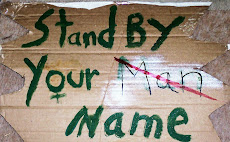
I found this piece on wearing a hijab interesting. In short, while I respect Nusrat's decision and wouldn't attempt to dispute it, it seems to me that countering provocative / revealing dress disguised as feminism or liberation with uncomfortable, over-covering garb doesn't really solve the problem of objectification or of promiscuity, does it?
Where I completely agree with Nusrat is where she says that her hijab conveys, “I control what you see”. I contend that the young woman who lets it all hang out, while claiming that she’s in control, is actually a victim of Western culture (mostly via advertising, which is mainly devised by men) telling her what she should allow us to see. How is that empowering? Yet for me, the antidote to promiscuity is not repression, or throwing on a burlap bag and “disappearing” the whole fashion question, but rather feminism, which I see as encompassing educating girls and young women to recognize objectification and exploitation while citing strategies they can use to achieve balance between asserting themselves and loving their bodies and ending up puppets of the corporate world.
As I wrote in an earlier post, while women and girls who dress revealingly get attention alright, they don’t get taken seriously. There’s a reason your attorney doesn’t show up in court showing cleavage, or your physician doesn’t make her rounds in Daisy Dukes. Our sexual parts are there, naturally; but just as we don’t use them in public, we don’t have to advertise them to the world. Does the physician walk around wearing her stethoscope outside the work setting? Does the attorney bring her briefcase to a party? I also question the claim that dressing revealingly is comfortable: I used to wear tube tops, and recall the relief at removing them at the end of the day: No more tugging and itching. And thongs? How comfortable is it walking around with fabric up your crack?
However, I’m not convinced the antidote to fashion slavery is to cover up a la hijab or burka, or long sleeves and stockings in 40 c. heat, a la Orthodox Jewish women, which to me are as uncomfortable as tube tops, if not more. Instead, what I tried to do with my own daughters was to introduce to them the shocking concept that “appealing” need not be synonymous with “sexy”. The obvious place to start was synagogue wear: “No, you may not bare your stomach / wear spaghetti straps / a miniskirt to shul”. Eventually they would put on an outfit and ask me, “Ima, is this OK for shul?” I’d point out any “transgressions”, and back they went to the closet to correct them. Of their own volition, they wear boxers over their (two-piece) swimsuit bottoms, because they feel more comfortable that way. I’d rather they wear one-piece swimsuits, but I accept their solution because I believe that giving them choices within reason is as important as their not looking like streetwalkers. And what do you know? They dress appealingly, yet not provocatively. They internalized the difference.
It’s all relative, of course I realize. My daughters’ elbows and knees are exposed, which is considered revealing in fundy circles. But their sexual parts are covered up, and they are therefore more likely to be taken seriously and less likely to be ogled than are young women whose same parts are hanging out there for all to see. And so I feel I’ve succeeded in transmitting to them the concept of dressing appropriately. In fact, I can’t recall a single battle over an item of clothing, either while clothes shopping or post-purchase. Of course, I began “rolling the tapes” early on about our bodies, objectification and exploitation, women’s images in advertising, and so forth. So my restrictions in dress — which don’t even look like restrictions to them — didn’t take place in a vacuum. This is what has worked for me, and what I recommend parents try.
The lines from Nusrat’s piece that struck a chord in me read: “I am … absolutely certain that the skewed perception of women’s equality as the right to bare our breasts [or other parts, as much as we can get away with - Y.E.] in public only contributes to our own objectification. I look forward to a whole new day when true equality will be had with women not needing to display themselves to get attention.” I wish Nusrat a pleasant journey in her new identity as a hijabi [shouldn’t there be a feminine form of that word?]. When all’s said and done, our society already shows plenty of collective skin. If it’s possible to err, let it be on the side of less skin being revealed, not more.
Showing posts with label modest dress; hijab לבוש צנוע; רעלה. Show all posts
Showing posts with label modest dress; hijab לבוש צנוע; רעלה. Show all posts
Tuesday, July 17, 2012


Subscribe to:
Posts (Atom)